I’m made of broken pieces –
Perhaps once part of a whole,
Not certain what the picture was
Before my image was no more.
Many have come to see them,
Sprawled across the floor –
Never to be as they were before
And never really wanting them in any other way
Than their lovely disarray.
Some saw me as a puzzle
And tried desperately to solve my soul,
Others saw just a mess
And left them and me alone.
A few saw a shot at chaos
And went ahead with their own smashing,
Sending my pieces flying carelessly around
As they bounced and bashed unbound…
And then there was you
Who looked at me from above
With tenderness and with love
And saw not the remains
Of something once whole
But the limitlessness
Of what could become of my soul.
My many sharp edges
Became treasures
Where the light reflected perfectly so.
The mismatched colors
Were a spectacle of wonder,
And the missing were never missed.
Hand over mine,
You guided me
With love and creativity,
And in a fashion nearly formulaic
You turned me into a beautiful mosaic.
#writers
Writing on the Line
Writers understand that there is a thin line between that which is largely considered acceptable content and that which is not. Some things live in this sort of gray area, like the tropics to the equator or the habitable zone around our sun. Others are close enough to the line that one might catch some flak from family or friends. Then there are the things on and beyond the line; and if you go far enough, leaving the relative warmth of questionable content and heading deeper into the shade, you will eventually enter the realm of anonymous publishing and unclaimed pseudonyms.
Truth be told, I have always written on the line – even at a fairly young age. I like the line. I enjoy being near it. It feels dangerous to explore the emotions that drive us to the edge of our comfort zone, to imagine which would put us over, and how it might feel to fall. Writing about those things seems considerably safer than actually being in the moment. Depending how far one’s imagination roams, however, the possibility of being drawn over the line in reality intensifies. There is a point at which life will begin to mimic art, and that point is always far more accessible to the artist than the observer. This risk is, for some, what makes the line so difficult to resist.
Writing is (or at least in my opinion, should be) a visceral experience. It starts with a spark – an idea, an image, a moment, a sensation, but it is only that – a spark. The real work is in seeing the story and understanding how deeply that story exists only because of the emotion generated by it. Stories are so thoroughly human. They live for no other reason than and are always about people – even a perspective of an inanimate object would have to be personified in order for its story to be told.
In this sense, we come to see that there is an emotional currency that is exchanged between writers and readers. Writers invest their time producing that which is intended to elicit the emotions their audience desires, while readers make their own investments in the hope of having a certain emotional experience. What any one reader desires is highly personal and quite varied, but in many cases it can be as simple as the desire to be happily entertained. With people seeking all kinds of responses, there are markets out there for everything – even for that which sits on and beyond the line.
In the case of writing on the line, the investment writers make is riskier. Aside from the obviously smaller markets and stronger need for anonymity, there is also the emotional risk. It is impossible to engage a reader in an emotion that is unexplored by the writer. Thus, we go, faithfully, courageously, into the wilds of the human mind. What we discover may be far too sensitive for us to write about, or perhaps we’ll uncover something in the gray area that touches us and we can embrace with careful arms. We might be appalled or enlightened. We can be turned off or turned on. Some writers will sit and stay, while others simply broaden their territory of enjoyable content and create diversity in their portfolio.
Call us literary thrill seekers, reckless writers lacking decorum or good sense, irreverent, or irresponsible, visceral junkies living vicariously through the intensities we’ve created in the name of art, people of passion to the extreme… Whatever judgments may befall us for our expeditions into places where society casts a disapproving shadow, we continue to go undaunted. Why? Because the greater the emotion, the greater the content; and who wants to write (or read) anything less than extraordinary?
The Marked
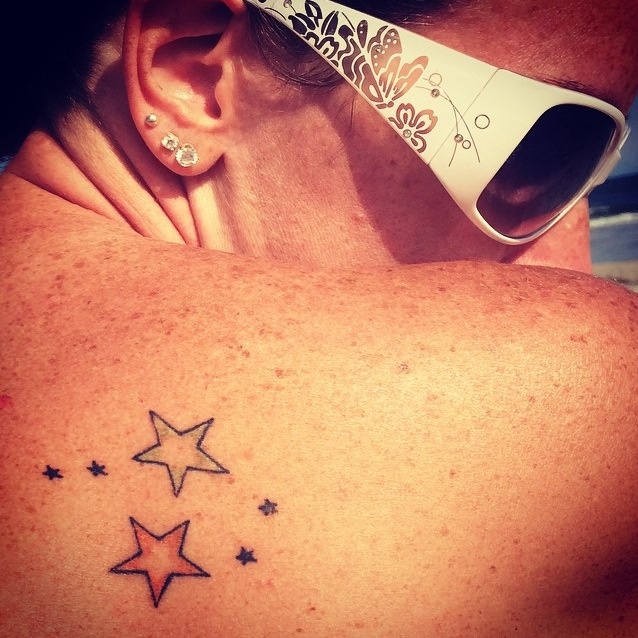
My sons and grandparents. One of my five tattoos so far.
The Marked
It’s sort of like an empty page,
A thing that calls from far away –
A vision of a piece of you,
A thought you have to say.
It grows into a yearning urge,
One that tingles, one that burns,
And whispers through to all you be
“You’re incomplete without me.”
A part of you, a shred of soul,
That’s pushing toward your surface.
A thing your heart just has to say
With volume and with purpose.
It creeps out through your very pores
‘Til you begin to see
Just how and where it needs to go,
Just how it’s supposed to be.
Before not long, you see it there
Invisible but clear –
The missing piece
Of you
Your soul,
Your heart
You have to wear
Upon your sleeve
Quite lit’rally –
No matter what the cost
Because this piece is breaking through
And without, you feel a loss.
So you go and collaborate
With another soul divine,
An artist who can replicate
The piece of heart, a sign
That spells out what you need it to,
To speak the words inside –
A language that is lost on most
You can no longer hide.
Forgive what judgment,
Forget the pain,
For nothing matters more
Than bringing out this piece of soul
Bursting from your core.
And when the buzzing ends,
And when the work is done,
You walk away with soulful peace
So grateful for the gun –
It gives to us
A way to tell
The things that lie within
That shape our minds,
That mend our lives,
That tell of who we’ve been.
And how it looks to others
Means nothing to The Marked
Because we know that what we’ve done
Is show a bit of heart.
If they should hate
Or cry
Or judge,
It is not ours to parry –
For we’re not meant to live beneath
The ceilings others carry.
The stars are ours.
The moons are, too.
The flowers and bones alike.
‘Cause when we look into the mirror
It’s what we see we like.
A part of us,
A piece of soul
That lies upon the skin
And speaks to us
And all around
Of who we are within.
When we behold and see it there
We feel a bit as though
We can’t imagine how we were
Before it came to show.
They say with age
You come to change
And turn on things you’ve placed
Upon your flesh –
They say “regret”
But I say that is based
On those who chose
A standard pose,
A picture piece, not of soul
That came to them
From their within,
And so it has grown old.
When you do this properly –
These marks, they are a part
Of all you are eternally
To death and from the start.
So when my ink is faded
And when my skin grows loose,
I’ll look upon my body
And know this profound truth:
That I lived upon this earth
In this here sack of skin
And never let society
Keep my soul within.
Some things were meant for hiding,
Some things were meant to speak,
And still others meant for sharing, for releasing
So they leak
Out of my mind
Out of my soul
And spill upon my flesh
That’s proud to show
My spirit’s glow
Until it’s laid to rest.
So fear not, hate not, wish not,
Cry not a single tear
For this to me is beauty,
And truth, and love adhered.
The Big Reveal – Poetry and the Author’s Veil
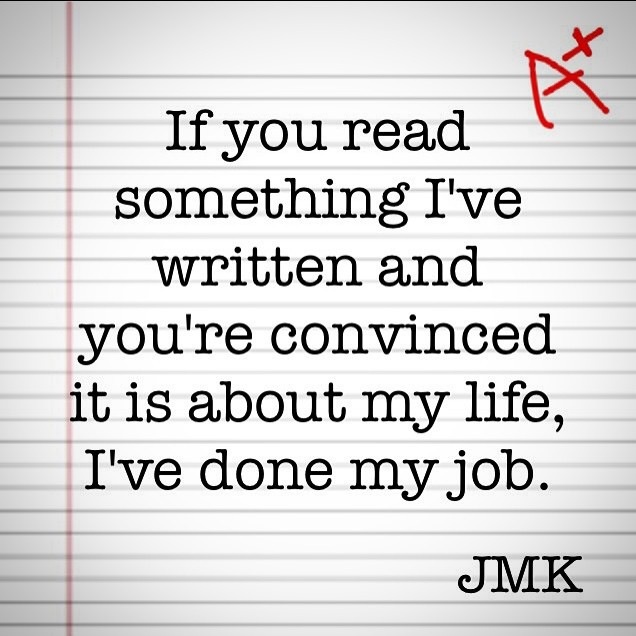
I have often been told, and more often cautiously reminded, how revealing poetry can be. It comes from a different place, they say. It tells a story about the author that no prose ever could. Does it? It seems fairly commonplace to believe that poetry is deeply revealing whether the author intends it or not, but I enjoy challenging that notion.
When I was a girl, probably somewhere in early middle school, I wrote a poem about a child murdering her incestuous father. I remember distinctly attempting to trigger a flare in the reader’s chest, a fire that rose in anger and left in its place the coolness of freedom. In my early 20’s, I wrote a poem in Shakespearian language as a middle-aged man who was undressing, for the first time, the woman he’d desired since boyhood… A personal favorite I intend to include in a larger work one day.
Now, I have never been a child victim turned murderer or a middle-aged man of the Elizabethan era… At least, not to my knowledge. Nonetheless, the poems were highly effective, deeply emotional, and physically stirring. So, who is to say that these works are any more or less revealing than the rest? One could suspect that I was the victim or perpetrator of an unspeakable crime as a child or that my narrative about the amorous couple hints at sexual secrets buried deep within, but readers tend not to assume these kinds of things because these conclusions seem like a stretch. So, readers decide the piece is simply well fictionalized. If I write about the more common events standard to fairly average lives, however, people are more willing to assume all kinds of biographical storylines – ones that may be comprised of equal parts fiction to those that are obviously invented.
When I was a college student – the first time, I was a theater major. One of the many things that I studied (well, as much as I did study…) during that time was Stanislavski. The fundamental idea we focused on was that acting has to come from somewhere. We were taught to draw upon a single life experience that produced the emotions most resembling those being called into the scene and apply them to the situation. It was a very powerful tool on the stage and proves to be just as impacting to the pen.
It is true that artists are creators, and everything we create is in some way an extension of ourselves. It is an emotional expression that is rooted somewhere in our human experience. That is not to say, however, that we have experienced all we exude… even when we are writing poetry. Although poetry certainly comes through on a different channel and has the potential to be more “revealing” than even the most impressive dossier, it is reductive to say that there is more truth about an author hidden in stanza than story. Many poets, with lyricists being one excellent example, weave perfect fiction into meters and rhyme. Frequently, the first person in a poem is just a character as in any other form of fiction, and all it takes to master the skill is a moderately successful trip through Acting 101.
So don’t believe everything you read in poetry. Just because we can make it roll deliciously off the lips and soul with all the rhythm and rhyme of musical meltdown doesn’t mean it is in any way a reflection of a reality in which we, the veiled poets, live. It only means that we are writing well, and that you – my friend – are susceptible to liars.
The Soul of A Place
Settled neatly and somewhat inconspicuously amid the tall trees and pitchy green slopes of Appalachia, there stands an old stone barn revived from the once homestead of a Scots-Irish immigrant and his robust family, heirs to nothing but soil and the piles of fieldstones that remain within and without this structure. The spider-like fingers of thick, ominous looking vines crawl along the broken remains of other walls, deep into the rotten wooden roof of a collapsed smokehouse, and along the heights of this unlikely remainder. Though well hidden from anyone not knowing its location, it is a hive the draws in those seeking that which it contains. They come in swarms to taste the sweet life it promises.
Inside, strings of white lights hang loosely over the low rafters the support a loft. The stone walls that have been covered in plaster and painted over and over now show countless peeling layers, speckles of color emerging from beneath the most recent, broken coat – a simple beige. Large pillar candles, all having seen their start long ago, are adhered to tattered tin trays by the craggy ranges of waxy mountains that have glided in sensuous slow motion down, down. They illuminate the bar and the handful of tabletops that sit mismatched underneath the loft’s shallow rise.
Beyond the aged wood beams through which breathes down the antique lightness of old souls, there is a wide opening presided over by a soaring ceiling of wide cedar planks. The only wall uninterrupted by the vacant loft seems to hold up the room, the entire building, single-handedly. High along the rising wall, the old stone peeks through where the thick overlay has come away, no doubt to the chagrin of those unwittingly below at the time. Topping it off, flying beams as thick and long as ship masts support the roof which glows from lights below and displays a spectacle of shadows black and linear. The light and dark play against one another like the stripes of a crazy quilt pieced together by the complicated hands of time and testimony, hinting at the checkered past of the many lives that have passed beneath them.
Framed in ramshackle best, a low stage sits in contrasting glory at the base of the hulking bulwark. Illuminated in vintage gold, two yellow hued lights hum in their places, metal clamped and shining with pride upwards from the illusion of a gas lit apron. Half-hung drapes, likely the used drop cloths of every restoration, dangle flush against the cool stone, plummeting swags of canvas that serve as both outline and backdrop. Vacant but commanding the attention of those who gather in its imminence, the stages waits with a restlessness uniform to that of the gathering crowd.
A coolness made crisp by the stream outside gives the air a chill that hides the spirits afoot. Years upon years, once limited on a newly settled landscape, now drift along the ebb and flow of centuries old drafts, relieving the room of the dust and doldrums so particular to others its age. Replacing the musk of rustic antiquity is a fresh air that nips coolly on bare shoulders and carries a cleansing hint of sunflower through the upper senses.
The rustling of flat shoes against the planks underfoot play the bass to a murmur of voices punctuated by bursts of laughter and the breaking of glass bottles tossed thoughtlessly into a bin of empty brothers. The tuning of strings and a roll of a snare drum, the whimper of a harmonica blown slowly begin to perforate the atonal chord being played by movement and conversation. With each poke at the crowd, more among it responses. A pop of applause. A single scream or shout. But each time, there is a dimming of distraction, a drawing toward the stage.
Sweating glasses find ledges on which to perch as audience meets show, and music – sweet music – begins to call the names of all attending with lyrics that tell the stories of a thousand men and women who’ve walked these woods innumerable nights and who’ll walk them immeasurable more. The pounding of boots, shouts of exaltation, and sighs of empathy are matched with hands to cover hearts and the combined sweat of dancers too close. Short skirts flare over nude legs trimmed in boots near purtier than the gal they rode in on as the room rises to meet the music in rapturous assembly. Hands glide to hips, slip through hair, or drop back and away. Swaying, spinning, and getting low, down low, while faces turn upward or downward to draw in the freedom from above or the intensity from below.
The moisture that once laid icy fingers on the soft shoulders of the young and hopeful selectively aiming their flirtatious glances now turns to steam. Each eye-sent invitation to dance brings the heat and raises the temperature as quickly as it raises the hopes of some and eyebrows of others. But it is the raising of glasses and bottles bottom up that keep it jovial while the audible delights lift the mood higher, sending it swirling to the vast expanse of celestial bodies once earthly and still dancing in this place – a place rich in storied layers of humanity’s existence and deeply in love with her vivid soul.
Some Prisons
Some prisons have walls
That reach to sky
Cells, fences, and gates
That roll powerfully by
Closing in prisoners
Cutting them off
From people and places
They’d formerly been caught.
Some prions have barriers
Invisible to see
That hold us in places
We’d rather not be
With or without
Fear, tear, or pout
They keep us from growing
They dry us right out.
Some prisons are lovely
Set on a hill
That overlooks freedom
But overthrows will
Or captures our hearts
Our spirits
Or minds
And trap us with things
Once wanton, divine.
Some prisons have names
Or titles attached
That hold us to standards
Or rumors
Or traps
Otherwise fine
To all but who know
Of the shackles they bear
Of the duty bestowed.
All prisons hold someone
Like you or like me
From being the person
We wanted to be.
So be it a fortress
Of crime or of fortune
Be it a choice
Or by nature’s contortion
Cometh by parentage
Or cast down as doom
We each find ourselves
Alone in that room
Under shadows that hang
Or with clasping cuff cuts
That slice like a knife
Through our throats
Or our guts
Our souls or our spirit
Our hopes and our dreams
And leave us to ponder
What life would’ve been
If not for the prisons
That capture us all
One way or another
Before that last call.
Parenthood
Laundry, bills, and paperwork,
Appointments, cleaning, go bizerk.
Balance checkbook, empty pails,
Birthday cards are in the mail.
Diarrhea, midnight feedings,
Potty training, endless needing.
Child proofing, baby gates…
Remember when we went on dates?
“Mommy, Mommy, I want more!”
“Why’s there poopy on the floor?!”
Cups get spilled and things get lost.
“Wait, how much does that thing cost?!”
Big toy messes, packing lunches,
Planning parties, huge time crunches.
Bathe the kids and take a shower,
Due to be there in an hour.
Baseball practice, football, hoops,
Momma’s taxi loop-de-loops.
Who was naughty, who feels sick.
10 billions times: “no throwing sticks!”
Homework, field trips, and flu shots.
Load the dishes, wash the pots.
Day for pictures, day for trash,
Day for… Ugh, is that a rash?
And in the middle of it all
The hubby makes a booty call.
Pack for school then pack for play,
Need a day off from vaca!
Teething, falls, emergencies.
Sibling fight, go referee.
Who had it first? Who took it last?
“Say that again, I’ll spank your…!”
Time out, crying, slamming doors,
Angry feet on hardwood floor.
“Child, I will not take this crap!”
Holy smoke, I need a nap.
Cell phones, tv, video games,
Way too much will rot your brains.
Elbows down and stand up straight,
Hurry now, or we’ll be late.
No hats inside; say thank you, please.
Scrub dirty toes, kiss scraped up knees.
Brush their teeth and comb their hair,
Clip the nails… “We almost there?”
High school drama in first grade.
“Mommy stay here, I’m afraid.”
Bring in the mail, toss out the junk,
Pay a tutor so they don’t flunk.
Back to school night, chorus, testing,
Sleeping over – never resting.
All this stuff seems never ending,
Fund raise, scouting, candy vending,
Teach to drive, to read, to eat,
Wash those butts and little feet,
Pregnancy worries, childbirth,
Remind me please what it’s all worth?
Give up your life, your waist, your fun
For all this stuff that’s never done.
Day after day after day after day,
And they’re the only ones who play.
But in the end, one thing is true,
You love them more than you love you,
So who cares if your hair has grayed,
Your house a wreck, your nerves all frayed?
You did for kids what you though was best,
And you hope they’re ready for the rest
Of their lives, which they will give
To yet another set of kids.
And so it goes, right down the path.
And somewhere in the aftermath,
You meet your spouse to glow together
In the clearing, sunny weather
Of children all raised
And beds all made
An empty nest.
Enjoy the rest,
Especially that side splitting stitch
That payback really is a _____.
19 Words To Make You Sweat
WARNING: Explicit Content
The following is a collection of nineteen word statements crafted as part of a personal exercise in skill-building. Though I plan to expand on this concept and create other topics of nineteen word sets, this introductory piece focuses on the wildly popular and forever taboo topic of physical intimacy, to put it politely. I encourage other writers to get in on the fun by posting their own nineteen word statements on the topic. Please be sure to use the hashtag: #19wordstomakeyousweat.
Needing
Folding
Rolling over
Like dough
But flesh
Raising and falling
Hot
Against
The softness of my bed sheets.
Coast across my skin
Your tongue
Wide
Flat
In perfect spoils
That chill my flesh
And burn my soul.
The depth at which
You come to be
Within
Is
The depth at which
I need you
To be.
Peel me back
Clenching fists
Arms and legs
Around you
List
When you let go
Trembling
For your return.
Long fingers
Stronger fingers
Wide cool palms
My sides
The path on which you ride
Into my very being.
Lay your body into me
Caress me deep
And soulfully
Do not wait
Or hesitate –
Inside
Each bit
Trembles.
Let us live forever
Immortal
In this space
Our own heaven
That exists
In every place our skin touches.
With a richness
In color
In shape
In depth
I welcome the drowning
Breathlessness
And desperation
Of this submission.
Growth Through Limitations
I’m not one for writing prompts in their most traditional sense. Personally, I never found it worthwhile for me to spend any amount of time writing on my character being in some situation beyond the reality I’ve constructed for them. I have never sent my heroine into a coffee shop only to discover she’d lost her wallet on the bus because there isn’t anything I can learn about my character participating in a scenario that exists entirely outside of her world. Making a list of penetrating questions and developing a solid dossier always seemed far more productive.
While writing prompts have never appealed to me, I have a respect for and understanding of the necessity to build agility, impact, and overall skillfulness regarding literary devices. My difficulty has always been finding exercises that develop these strengths without dragging my out-of-the-ordinary characters through everyday mediocrity as part of their practice.
Like all writers, I presume, I tend to experience what I refer to as drips: standalone sentences, two-minute long dialogue exchanges, and simple statements that spill out of my brain and onto paper. Sometimes they are junk, but other times they are brilliant and not to be ignored. After all, just because I’m not writing a larger piece that would include a particular sentence doesn’t mean the sentence itself is not worth being shared.
As writers, we take those random thoughts and squirrel them away, leaving them in piles of other scrapes, a treasure trove of future inspiration or a pile of garbage we only peruse when we are drunk and feeling the pressure of writer’s block and its accompanying self-pity. But what if we could use them as building blocks with which we can develop the aforementioned skillset?
Much the way a visual artist might doodle as a means of playing with ideas and practicing techniques, creating parameters in which to manage these drips gives us the chance to develop our skills. It is a realization that I had while rock climbing, of all things. In climbing, I am learning that by limiting options along the route, I am forced to see my situation with a greater sense of creativity, to take bigger risks, and to balance style with learned technique. Why not manage these writing drips in the same way?
Thus, I have designed for myself a limitation… Use exactly 19 words to make a single statement with as much skill and impact as I can conjure. Why 19? Because 18 didn’t seem like enough, and 20 was overkill. What an odd number, 19. It never gets any play.
Over the next several months, I will be posting to Instagram and Twitter hashtags that use this 19 word format. The first to be rolled out is #19wordstomakeyousweat, and it focuses on the erotic. Writing, much like speaking and reading, about sex is something that many enjoy but few share. (My, what would so many be reading if not for those of us willing to put the words together and let others read them?) My hope is that others will join in and use the hashtag to share their 19 words… both in this introductory exercise and in those still forthcoming. I’ll be posting my own collections here on the blog, and sharing some of them via Instagram and Twitter. If you’d like to play along, please feel free to post in the comments on my blog, or to use the hashtag across social media.
Enjoy. Have fun. Let go. As artists, our best work is the product we get when we combine both our creativity and our courage. Take the chain off and run with it.
The Square Lens
True artists rarely have one form of expression. Though most of us have a preferred manner of speaking, if you will, it hardly prohibits us from babbling in other languages. We can’t help it. Creativity is not a singular experience, nor is it inspired by one thing. Creative people are mediums who channel an energy that can come through in any number of ways. We can see a painting and write a poem, or read a poem and paint a scene.
I have always had a strong attraction to visual arts, though words are my favorite tool. I can put a pen to paper and generate emotion, display images, introduce people to the world, and create entire universes. For me, the writing experience is highly visual, however. I see everything I write. I have never, conversely, been able to recreate those images with the same level of accuracy using any other tool – a frustrating reality for a person who loves working in the visual medium.
While my paints, pastels, and pencils may wield their own unique style – one which I do not necessarily love and can’t seem to alter, I have discovered a newer form of visual expression that has proved to be both satisfying and inspired. Instagram.
I’m sure every digital artist in the room has just sighed and possibly choked back a bit of their last meal, but hear me out.
There is a natural pairing between words and images. They speak to and inspire one another. The world is full of snapshots, tiny visual blips that exist in millions of spaces and at any given second… The turning spokes of a bicycle wheel as it rolls past the rigid immobility of a sewer grate… A vulture’s perch on a playground post… The softness of a flower somehow growing from the crevice of a stone… As a writer, I look at these things and see emotions, stories, poems, single sentences, lists of adjectives. Capturing these blips gives me that chance to share the visual experiences in life that inspire me. The option to adjust filters, angels, and finishes only extends and enhances the creative experience. Simple applications that allow me to lay the words I see across that image bring me to a state of digital ecstasy, allowing me to indulge in an entirely new medium.
Like many writers on Instagram, I am writing in a whole new way, drawing in followers using art conveyed with the split-second swiftness we have come to expect in the digital age. Squared off click-bait that must not only get attention but compel those that view it to want more of what I can provide. Learning to use these tools to promote myself as an artist of both words and images is vital to my success in the professional sense, but it is also wildly amusing and deeply inspiring… The world becomes a highly flammable substance with which I fuel the fires of my creativity.
Sure, there are tons of annoying “chat live” ladies and countless narcissists posting half-nude duck-faced selfies… But never let the glare of some make you blind to the beauty of all who lie in the shadows. Art is everywhere, even on Instagram. We need only open our eyes to it.
 Jill-Arcangela Mancuso
You must be logged in to post a comment.