The pieces are crumbling
Breaking away
Like clay
From the solid form that once surrounded me
Defined me
Was all that I knew
That was built upon you
But now
It’s powder
Just dust
Fistfuls of dirt
On the winds of my changing fortunes
Sand clouds in the desert
I woke in
When the rumbling stopped
When the crashing ceased
When the path that I walked left me weak and diseased
And as the ringing in my ears dulls to a scream
All I can think
Is why,
Why does this keep happening?
Where is the man for whom I can build a castle
A temple
And a throne?
Maybe he’s been
Nothing but a dream
All along.
The Seed
I’m waiting
warm and silent
the pain of the split is over
new shoots of life
wriggle through the cracks in me
reaching slowly
gently
carefully
into my surroundings
selectively seeking
that which will nourish
and protect
not needing the sun just yet
held in the comfortable darkness
the world above
a whispering future
I am ready but not anxious for
the sun
a reward
for the struggle behind me
a promise
of the days before me
but for now
I’m waiting
open and ready
patient and free
warm and silent
The Gentleman Gypsy
In caramels tones
He walks through scared spaces
Seeing the world
Through the eyes of a wandering soul
Ageless and free.
He’s made his way
Down a strange and varied path
Winding, weaving
But as wide as the mind inside.
His narrow gaze
Casual in its reception
Reflects the miles it has seen
But he averts it
To keep the distance from those he needs not connection.
His demeanor pleasant
But controlled
An enigma
A stoic
With a broad laugh
And a devilish grin
That is as deadly as it is inviting.
Inside he is hot
A fire creative, colored, divine
Licking his life, his spirit, his sex
But breathing beneath
A water-like surface cool to the eye
Serene and complex.
Good temperament
Earns him favor
Respect
While he succumbs to his need
To give and protect
It roots him to many who know him
But by little more than reputation
And name.
He sleeps in places
Not his own
But has made to his abode
For however long this piece lasts
And that’s somehow unknown.
His place
Like his soul
Is centuries old
And he respects what is gold
To those who know the value of that which is priceless
Of wood and of glass
And of the poor man’s past.
He labors long
His hands set working
To give new life to old things
His taste not fine
But telling
Of lives he might have lived and lost.
The art of men just like him
The things they labored over
Sit good as new with dust in corners
Unhung
They’re waiting
For the man to find his home.
Lankily, he goes
Tall in his domaine
Which travels on his spirit
Set to ever roam
Until the gentleman gypsy
Comes to meet his own.
The Honey Go
They hurry to the hive
Making stops at where the fluids flow
Moving smoothly as they come and go
And whisper as they pass
In hums and beats that ripple like wings
And tickle their feets
And then the honey go.
With wiggling tails
And suspenders pulled
Wide out from chests that heave and ho
Deep down in the honeycomb
They swing around
In joyful bellows
With their happy fellow fellows
And shake when the honey go.
In glistening golds and browns
It pours unto and all around
Coating everything in its soul
Pulling people from their seats
Drawing them across the floor
Toward the so so sweet
That they call the honey go.
Voices shout and vocalists pout
And guitars slide so long
Spilling into the room
The richest, rightest of all the finest
Sounds that ever were
Weeping and groaning
Soulfully moaning
The achingly sexy hue
Of all that flows and alluringly goes
From show to show to show
And at every turn
They come to buzz
About where the honey go.
February 6, 2014
This poem was inspired by the blues club scene from the movie Black Snake Moan with Samuel L. Jackson and Christina Ricci.
Catharsis and the Captive Soul
Some of us are captives. We are imprisoned by the world and even the very bodies in which we live. We have a terrible and insatiable desire for freedom from all that is and all that we are. We express ourselves in a myriad of passions in an effort to exude our existence and find release from our thoughts and emotions. We breathe ourselves out, making heat marks on the windows of the world, and we constantly daydream about how to break the glass and the adventures of escape beyond. Resisting our instincts leaves deep wells of insecurity and knots of anxiety that trap us in a maze of discontentment and indecision. Our minds are busy, our hearts are raw, and we seek, above all things, catharsis.
I was not particularly familiar with the word “catharsis” until recently when I smashed the foggy glass of my most inner prison. Led by a reconnection with my art, I had to relocate my inner voice. I had no idea where I would find it, as it had been so long since I’d listened… Perhaps, I never truly had at all. My search brought me to a point of introspection and eventually self-dismemberment. Anyone who has ever screwed up an assembly can tell that, at some point, the best idea becomes to just take the whole damn thing apart and start over.
As I listened, I honed in on its location and followed the sounds. Soon, I found myself headlong down the rabbit hole called Me. I’m not sure if I jumped. Maybe I tripped and fell. My leading suspicion, however, is that Fate pushed me. Whatever the circumstances of the plunge, they are irrelevant as I tumble to the depths of my soul, through the menagerie of images both lovely and terrifying. I have no idea where the bottom is or what I will find when I get there but, truth be told, it doesn’t much matter because the drop is cathartic.
There is something about being at odds with yourself that forces you to change your paradigm. The path to a new definition is literally mapped by emotional conflict – each one ending, as all conflict does, with resolution. Without said ending, the conflict would simply continue. In order to move forward, one must pass through, first, peril then release. So, like a ragdoll down the hallway stairs, I list as I fall, feeling pain only when I tense against the inevitable impacts. The greater my resistance, the greater the pain, and the greater my peril, the greater the release. Thus leading me to the conclusion that the less I resist and the more I welcome the discomfort of self-evolution, the less painful and more cathartic the experience becomes.
The question one would ask is, of course, what is at the bottom? Just another paradigm, I suppose; another set of windows to breathe upon and tap at while I build up the courage and that which I will free myself of in the next plummet. An endless series of falls, each one a search for weightlessness, for split seconds of perfect freedom, for the enrapturing moments of catharsis… Such is the journey of the captive soul.
In many ways, writing helps this process because it gives me a chance to deepen my experience by forcing me to put my thoughts and feelings into words. It makes me look at the central issues of each conflict and expand them with focus and meaning. If I can transfer what I am feeling into a set of words, I am naming the parts that contribute to the whole, breaking down the pieces, and examining how they interact with one another. I am essentially explaining it to myself. What I discover about myself and the conflict are not always what I wish to be the case and it often tightens the knot of peril, but when I consider the heightened release I find it is usually a worthwhile exchange – even if it is less than comfortable.
The interesting thing about being among these captive souls, about catharsis in general, and about living this experience as an artist is the inescapable nature of these circumstances. Play as I might at suburban housewife, at mother and baker of kindergarten party treats, I understand that at the core of me, I am indeed this first. I can take on duties, titles, and responsibilities of all types, but at the end of the day the thing I desire most is to sit and write and breathe against the glass… tap, tap, tapping away and dreaming of how the shards will fly as I break through to the next drop – free and cathartic.
He Made Me
I’m made of broken pieces –
Perhaps once part of a whole,
Not certain what the picture was
Before my image was no more.
Many have come to see them,
Sprawled across the floor –
Never to be as they were before
And never really wanting them in any other way
Than their lovely disarray.
Some saw me as a puzzle
And tried desperately to solve my soul,
Others saw just a mess
And left them and me alone.
A few saw a shot at chaos
And went ahead with their own smashing,
Sending my pieces flying carelessly around
As they bounced and bashed unbound…
And then there was you
Who looked at me from above
With tenderness and with love
And saw not the remains
Of something once whole
But the limitlessness
Of what could become of my soul.
My many sharp edges
Became treasures
Where the light reflected perfectly so.
The mismatched colors
Were a spectacle of wonder,
And the missing were never missed.
Hand over mine,
You guided me
With love and creativity,
And in a fashion nearly formulaic
You turned me into a beautiful mosaic.
Writing on the Line
Writers understand that there is a thin line between that which is largely considered acceptable content and that which is not. Some things live in this sort of gray area, like the tropics to the equator or the habitable zone around our sun. Others are close enough to the line that one might catch some flak from family or friends. Then there are the things on and beyond the line; and if you go far enough, leaving the relative warmth of questionable content and heading deeper into the shade, you will eventually enter the realm of anonymous publishing and unclaimed pseudonyms.
Truth be told, I have always written on the line – even at a fairly young age. I like the line. I enjoy being near it. It feels dangerous to explore the emotions that drive us to the edge of our comfort zone, to imagine which would put us over, and how it might feel to fall. Writing about those things seems considerably safer than actually being in the moment. Depending how far one’s imagination roams, however, the possibility of being drawn over the line in reality intensifies. There is a point at which life will begin to mimic art, and that point is always far more accessible to the artist than the observer. This risk is, for some, what makes the line so difficult to resist.
Writing is (or at least in my opinion, should be) a visceral experience. It starts with a spark – an idea, an image, a moment, a sensation, but it is only that – a spark. The real work is in seeing the story and understanding how deeply that story exists only because of the emotion generated by it. Stories are so thoroughly human. They live for no other reason than and are always about people – even a perspective of an inanimate object would have to be personified in order for its story to be told.
In this sense, we come to see that there is an emotional currency that is exchanged between writers and readers. Writers invest their time producing that which is intended to elicit the emotions their audience desires, while readers make their own investments in the hope of having a certain emotional experience. What any one reader desires is highly personal and quite varied, but in many cases it can be as simple as the desire to be happily entertained. With people seeking all kinds of responses, there are markets out there for everything – even for that which sits on and beyond the line.
In the case of writing on the line, the investment writers make is riskier. Aside from the obviously smaller markets and stronger need for anonymity, there is also the emotional risk. It is impossible to engage a reader in an emotion that is unexplored by the writer. Thus, we go, faithfully, courageously, into the wilds of the human mind. What we discover may be far too sensitive for us to write about, or perhaps we’ll uncover something in the gray area that touches us and we can embrace with careful arms. We might be appalled or enlightened. We can be turned off or turned on. Some writers will sit and stay, while others simply broaden their territory of enjoyable content and create diversity in their portfolio.
Call us literary thrill seekers, reckless writers lacking decorum or good sense, irreverent, or irresponsible, visceral junkies living vicariously through the intensities we’ve created in the name of art, people of passion to the extreme… Whatever judgments may befall us for our expeditions into places where society casts a disapproving shadow, we continue to go undaunted. Why? Because the greater the emotion, the greater the content; and who wants to write (or read) anything less than extraordinary?
The Marked

My sons and grandparents. One of my five tattoos so far.
The Marked
It’s sort of like an empty page,
A thing that calls from far away –
A vision of a piece of you,
A thought you have to say.
It grows into a yearning urge,
One that tingles, one that burns,
And whispers through to all you be
“You’re incomplete without me.”
A part of you, a shred of soul,
That’s pushing toward your surface.
A thing your heart just has to say
With volume and with purpose.
It creeps out through your very pores
‘Til you begin to see
Just how and where it needs to go,
Just how it’s supposed to be.
Before not long, you see it there
Invisible but clear –
The missing piece
Of you
Your soul,
Your heart
You have to wear
Upon your sleeve
Quite lit’rally –
No matter what the cost
Because this piece is breaking through
And without, you feel a loss.
So you go and collaborate
With another soul divine,
An artist who can replicate
The piece of heart, a sign
That spells out what you need it to,
To speak the words inside –
A language that is lost on most
You can no longer hide.
Forgive what judgment,
Forget the pain,
For nothing matters more
Than bringing out this piece of soul
Bursting from your core.
And when the buzzing ends,
And when the work is done,
You walk away with soulful peace
So grateful for the gun –
It gives to us
A way to tell
The things that lie within
That shape our minds,
That mend our lives,
That tell of who we’ve been.
And how it looks to others
Means nothing to The Marked
Because we know that what we’ve done
Is show a bit of heart.
If they should hate
Or cry
Or judge,
It is not ours to parry –
For we’re not meant to live beneath
The ceilings others carry.
The stars are ours.
The moons are, too.
The flowers and bones alike.
‘Cause when we look into the mirror
It’s what we see we like.
A part of us,
A piece of soul
That lies upon the skin
And speaks to us
And all around
Of who we are within.
When we behold and see it there
We feel a bit as though
We can’t imagine how we were
Before it came to show.
They say with age
You come to change
And turn on things you’ve placed
Upon your flesh –
They say “regret”
But I say that is based
On those who chose
A standard pose,
A picture piece, not of soul
That came to them
From their within,
And so it has grown old.
When you do this properly –
These marks, they are a part
Of all you are eternally
To death and from the start.
So when my ink is faded
And when my skin grows loose,
I’ll look upon my body
And know this profound truth:
That I lived upon this earth
In this here sack of skin
And never let society
Keep my soul within.
Some things were meant for hiding,
Some things were meant to speak,
And still others meant for sharing, for releasing
So they leak
Out of my mind
Out of my soul
And spill upon my flesh
That’s proud to show
My spirit’s glow
Until it’s laid to rest.
So fear not, hate not, wish not,
Cry not a single tear
For this to me is beauty,
And truth, and love adhered.
The Big Reveal – Poetry and the Author’s Veil
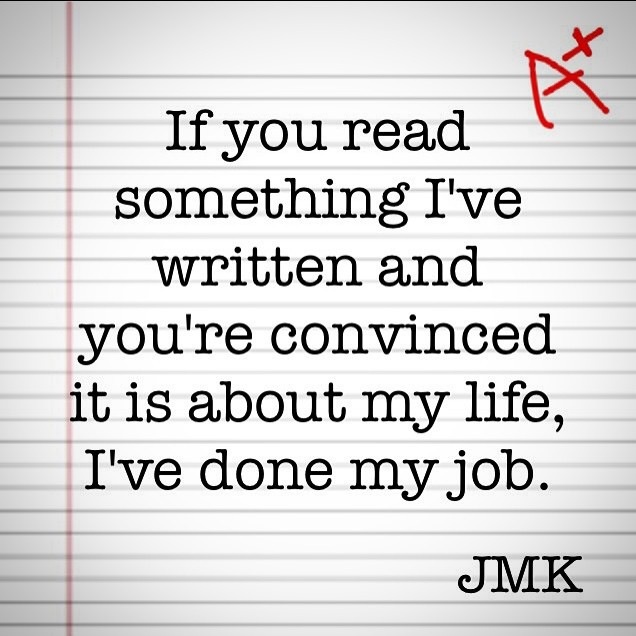
I have often been told, and more often cautiously reminded, how revealing poetry can be. It comes from a different place, they say. It tells a story about the author that no prose ever could. Does it? It seems fairly commonplace to believe that poetry is deeply revealing whether the author intends it or not, but I enjoy challenging that notion.
When I was a girl, probably somewhere in early middle school, I wrote a poem about a child murdering her incestuous father. I remember distinctly attempting to trigger a flare in the reader’s chest, a fire that rose in anger and left in its place the coolness of freedom. In my early 20’s, I wrote a poem in Shakespearian language as a middle-aged man who was undressing, for the first time, the woman he’d desired since boyhood… A personal favorite I intend to include in a larger work one day.
Now, I have never been a child victim turned murderer or a middle-aged man of the Elizabethan era… At least, not to my knowledge. Nonetheless, the poems were highly effective, deeply emotional, and physically stirring. So, who is to say that these works are any more or less revealing than the rest? One could suspect that I was the victim or perpetrator of an unspeakable crime as a child or that my narrative about the amorous couple hints at sexual secrets buried deep within, but readers tend not to assume these kinds of things because these conclusions seem like a stretch. So, readers decide the piece is simply well fictionalized. If I write about the more common events standard to fairly average lives, however, people are more willing to assume all kinds of biographical storylines – ones that may be comprised of equal parts fiction to those that are obviously invented.
When I was a college student – the first time, I was a theater major. One of the many things that I studied (well, as much as I did study…) during that time was Stanislavski. The fundamental idea we focused on was that acting has to come from somewhere. We were taught to draw upon a single life experience that produced the emotions most resembling those being called into the scene and apply them to the situation. It was a very powerful tool on the stage and proves to be just as impacting to the pen.
It is true that artists are creators, and everything we create is in some way an extension of ourselves. It is an emotional expression that is rooted somewhere in our human experience. That is not to say, however, that we have experienced all we exude… even when we are writing poetry. Although poetry certainly comes through on a different channel and has the potential to be more “revealing” than even the most impressive dossier, it is reductive to say that there is more truth about an author hidden in stanza than story. Many poets, with lyricists being one excellent example, weave perfect fiction into meters and rhyme. Frequently, the first person in a poem is just a character as in any other form of fiction, and all it takes to master the skill is a moderately successful trip through Acting 101.
So don’t believe everything you read in poetry. Just because we can make it roll deliciously off the lips and soul with all the rhythm and rhyme of musical meltdown doesn’t mean it is in any way a reflection of a reality in which we, the veiled poets, live. It only means that we are writing well, and that you – my friend – are susceptible to liars.
The Soul of A Place
Settled neatly and somewhat inconspicuously amid the tall trees and pitchy green slopes of Appalachia, there stands an old stone barn revived from the once homestead of a Scots-Irish immigrant and his robust family, heirs to nothing but soil and the piles of fieldstones that remain within and without this structure. The spider-like fingers of thick, ominous looking vines crawl along the broken remains of other walls, deep into the rotten wooden roof of a collapsed smokehouse, and along the heights of this unlikely remainder. Though well hidden from anyone not knowing its location, it is a hive the draws in those seeking that which it contains. They come in swarms to taste the sweet life it promises.
Inside, strings of white lights hang loosely over the low rafters the support a loft. The stone walls that have been covered in plaster and painted over and over now show countless peeling layers, speckles of color emerging from beneath the most recent, broken coat – a simple beige. Large pillar candles, all having seen their start long ago, are adhered to tattered tin trays by the craggy ranges of waxy mountains that have glided in sensuous slow motion down, down. They illuminate the bar and the handful of tabletops that sit mismatched underneath the loft’s shallow rise.
Beyond the aged wood beams through which breathes down the antique lightness of old souls, there is a wide opening presided over by a soaring ceiling of wide cedar planks. The only wall uninterrupted by the vacant loft seems to hold up the room, the entire building, single-handedly. High along the rising wall, the old stone peeks through where the thick overlay has come away, no doubt to the chagrin of those unwittingly below at the time. Topping it off, flying beams as thick and long as ship masts support the roof which glows from lights below and displays a spectacle of shadows black and linear. The light and dark play against one another like the stripes of a crazy quilt pieced together by the complicated hands of time and testimony, hinting at the checkered past of the many lives that have passed beneath them.
Framed in ramshackle best, a low stage sits in contrasting glory at the base of the hulking bulwark. Illuminated in vintage gold, two yellow hued lights hum in their places, metal clamped and shining with pride upwards from the illusion of a gas lit apron. Half-hung drapes, likely the used drop cloths of every restoration, dangle flush against the cool stone, plummeting swags of canvas that serve as both outline and backdrop. Vacant but commanding the attention of those who gather in its imminence, the stages waits with a restlessness uniform to that of the gathering crowd.
A coolness made crisp by the stream outside gives the air a chill that hides the spirits afoot. Years upon years, once limited on a newly settled landscape, now drift along the ebb and flow of centuries old drafts, relieving the room of the dust and doldrums so particular to others its age. Replacing the musk of rustic antiquity is a fresh air that nips coolly on bare shoulders and carries a cleansing hint of sunflower through the upper senses.
The rustling of flat shoes against the planks underfoot play the bass to a murmur of voices punctuated by bursts of laughter and the breaking of glass bottles tossed thoughtlessly into a bin of empty brothers. The tuning of strings and a roll of a snare drum, the whimper of a harmonica blown slowly begin to perforate the atonal chord being played by movement and conversation. With each poke at the crowd, more among it responses. A pop of applause. A single scream or shout. But each time, there is a dimming of distraction, a drawing toward the stage.
Sweating glasses find ledges on which to perch as audience meets show, and music – sweet music – begins to call the names of all attending with lyrics that tell the stories of a thousand men and women who’ve walked these woods innumerable nights and who’ll walk them immeasurable more. The pounding of boots, shouts of exaltation, and sighs of empathy are matched with hands to cover hearts and the combined sweat of dancers too close. Short skirts flare over nude legs trimmed in boots near purtier than the gal they rode in on as the room rises to meet the music in rapturous assembly. Hands glide to hips, slip through hair, or drop back and away. Swaying, spinning, and getting low, down low, while faces turn upward or downward to draw in the freedom from above or the intensity from below.
The moisture that once laid icy fingers on the soft shoulders of the young and hopeful selectively aiming their flirtatious glances now turns to steam. Each eye-sent invitation to dance brings the heat and raises the temperature as quickly as it raises the hopes of some and eyebrows of others. But it is the raising of glasses and bottles bottom up that keep it jovial while the audible delights lift the mood higher, sending it swirling to the vast expanse of celestial bodies once earthly and still dancing in this place – a place rich in storied layers of humanity’s existence and deeply in love with her vivid soul.
 Jill-Arcangela Mancuso
You must be logged in to post a comment.