Write Or Die

I have come to an impasse.  For years, decades – in fact, I have taken the roads others have encouraged or demanded of me or abandoned those that asked too much or too little.  Now, at the midpoint of my life, I find myself with nothing to show but expired certifications, unused degrees, and dusty accolades no longer relevant to any course I care to walk. 

My brief adventure in theater ended when I declined a spot on the casting couch.  I assumed the girl who got that part accepted.  Having encountered the same offer at my next big audition, I lost my taste for the business.  If I wanted to be a sex worker, I would swing from a pole and make considerably more money with significantly less rejection and effort.  I decided to wait tables and recalibrate.

A few years later, I went to school for Education, but all ambition I had to inspire children went out the window when I was told by a principle my lesson plans were “too interesting and creative,” that I needed to “focus on the [state-mandated, standardized] test,” and I needed to “stop working so hard.”  I switched districts and found new footing, but my first child came and I decided to stay home during the early years.  When I returned, five years later, I found out I had to start over.  From the bottom.  That meant substitute teaching and working as an aide, making copies and helping students use the toilet for poverty wages and welfare insurance.  At the time, I was a single parent with a chronic “non-payer” for a co-parent, busting my tail to survive.  In advocation for my students with unique needs, I’d made a pest of myself in the eyes of administration.  After three years of bureaucratic melodrama and literal ass-wiping, having been passed over for a promotions twice because I was “too valuable” in my position, I decided maybe this line of bullshit – I mean, work – just wasn’t for me.

So, off I went to real estate – the BYO of business.  Bring your own license.  Bring your own funding.  Bring your own training.  Bring your own signs, folders, business cards, office fees, copies, access to necessary associations and inventory lists, …  Hell, bring your own customers.  You’re basically paying thousands of dollars each year to the state and the office to provide you with a theoretical structure in which to operate your independent business.  I adore working with people on the sale and purchase of properties.  Trouble is, you need people to work with, and without thousands to spend annually on BYO marketing, research, and advertising, you’re chasing your tail.

Exhausted from trying to catch the fluffy end of my own existence, I circled back around to where I tend to end up: standing alone and in peril, wondering what the next thing is.  What I am finally realizing is that the reason I was ever any good at anything at all is because I write well, the thing that I enjoy doing the most is writing, and that no one – despite countless applications and efforts, no one – is going to pay me to do it for them.

Sure, I could take the fraction of a penny per word jobs.  I could earn a whopping $20 for ten 1700 word articles per week.  (Yes, that was an actual job posting.)  I could also shovel shit at the zoo.  I’d certainly earn more money in less time.  I have a family to feed, and I don’t have time to waste helping those who are both incapable of working my craft and unwilling to adequately compensate me to work it for them.  Eight years after ghostwriting a novelette that never made it to print, I am still kicking myself for letting the rough draft slip away into the expanse of great work never to see the light of day, dropped by hands unable to carry it across the finish line.  It’s almost as saddening as the freelance writing prospects out there.

Meanwhile, the web dumps pages of new content written by communications majors without the good sense or grammar of a middle schooler writing a bullshit essay on a standardized test.  Yet, these jobs are impossibly hard to get and pay little more than one would earn managing the local table-service chain, refunding overcooked steaks and calling Ubers for the Flagged On A Friday regulars. 

Thus, here, we find the impasse.

What is a writer to do in a world that values craft less than word count or click-throughs?  …Where those looking for quality in content are dreamers with shallow pockets hoping to turn a nickel into bait for the broke and talented?  …Where the Learned It On TikToker crowd wants to pay you $15 to write them a book they’ll upload to Audible and make thousands on?

If there is no money in writing for others, one must writer for oneself, and that means getting publishing.

There is no other direction I can go.  Trapped in a labyrinth of failed career choices and dead ends, I have no path but the one laid out before me, the one that leads to the only way out. It’s the one on which I will write my way out.

Many years ago, upon completing my master’s in education, I considered getting a doctorate and pursuing a career as a college professor.  My father cautioned me about the necessity to “publish or perish” when working in the highest levels of education.  A professor who does not write a critical manuscript in their field is as good as gone.  It seems this adorable, albeit threatening, alliterative is now true to life for me anyway. 

As a person who has made a career of leaving jobs that proved financially or spiritually impoverishing, and who has only ever really been skillful at one thing, writing my way out of this life and into the one I want is the only option.  I simply must get my manuscripts bound and on shelves. 

And so the music rings in my head, “Live, life, live, [write] or die.”
Catharsis and the Captive Soul

Some of us are captives. We are imprisoned by the world and even the very bodies in which we live. We have a terrible and insatiable desire for freedom from all that is and all that we are. We express ourselves in a myriad of passions in an effort to exude our existence and find release from our thoughts and emotions. We breathe ourselves out, making heat marks on the windows of the world, and we constantly daydream about how to break the glass and the adventures of escape beyond. Resisting our instincts leaves deep wells of insecurity and knots of anxiety that trap us in a maze of discontentment and indecision. Our minds are busy, our hearts are raw, and we seek, above all things, catharsis.

I was not particularly familiar with the word “catharsis” until recently when I smashed the foggy glass of my most inner prison. Led by a reconnection with my art, I had to relocate my inner voice. I had no idea where I would find it, as it had been so long since I’d listened… Perhaps, I never truly had at all. My search brought me to a point of introspection and eventually self-dismemberment. Anyone who has ever screwed up an assembly can tell that, at some point, the best idea becomes to just take the whole damn thing apart and start over.

As I listened, I honed in on its location and followed the sounds. Soon, I found myself headlong down the rabbit hole called Me. I’m not sure if I jumped. Maybe I tripped and fell. My leading suspicion, however, is that Fate pushed me. Whatever the circumstances of the plunge, they are irrelevant as I tumble to the depths of my soul, through the menagerie of images both lovely and terrifying. I have no idea where the bottom is or what I will find when I get there but, truth be told, it doesn’t much matter because the drop is cathartic.

There is something about being at odds with yourself that forces you to change your paradigm. The path to a new definition is literally mapped by emotional conflict – each one ending, as all conflict does, with resolution. Without said ending, the conflict would simply continue. In order to move forward, one must pass through, first, peril then release. So, like a ragdoll down the hallway stairs, I list as I fall, feeling pain only when I tense against the inevitable impacts. The greater my resistance, the greater the pain, and the greater my peril, the greater the release. Thus leading me to the conclusion that the less I resist and the more I welcome the discomfort of self-evolution, the less painful and more cathartic the experience becomes.

The question one would ask is, of course, what is at the bottom? Just another paradigm, I suppose; another set of windows to breathe upon and tap at while I build up the courage and that which I will free myself of in the next plummet. An endless series of falls, each one a search for weightlessness, for split seconds of perfect freedom, for the enrapturing moments of catharsis… Such is the journey of the captive soul.

In many ways, writing helps this process because it gives me a chance to deepen my experience by forcing me to put my thoughts and feelings into words. It makes me look at the central issues of each conflict and expand them with focus and meaning. If I can transfer what I am feeling into a set of words, I am naming the parts that contribute to the whole, breaking down the pieces, and examining how they interact with one another. I am essentially explaining it to myself. What I discover about myself and the conflict are not always what I wish to be the case and it often tightens the knot of peril, but when I consider the heightened release I find it is usually a worthwhile exchange – even if it is less than comfortable.

The interesting thing about being among these captive souls, about catharsis in general, and about living this experience as an artist is the inescapable nature of these circumstances. Play as I might at suburban housewife, at mother and baker of kindergarten party treats, I understand that at the core of me, I am indeed this first. I can take on duties, titles, and responsibilities of all types, but at the end of the day the thing I desire most is to sit and write and breathe against the glass… tap, tap, tapping away and dreaming of how the shards will fly as I break through to the next drop – free and cathartic.

Writing on the Line

Writers understand that there is a thin line between that which is largely considered acceptable content and that which is not. Some things live in this sort of gray area, like the tropics to the equator or the habitable zone around our sun. Others are close enough to the line that one might catch some flak from family or friends. Then there are the things on and beyond the line; and if you go far enough, leaving the relative warmth of questionable content and heading deeper into the shade, you will eventually enter the realm of anonymous publishing and unclaimed pseudonyms.

Truth be told, I have always written on the line – even at a fairly young age. I like the line. I enjoy being near it. It feels dangerous to explore the emotions that drive us to the edge of our comfort zone, to imagine which would put us over, and how it might feel to fall. Writing about those things seems considerably safer than actually being in the moment. Depending how far one’s imagination roams, however, the possibility of being drawn over the line in reality intensifies. There is a point at which life will begin to mimic art, and that point is always far more accessible to the artist than the observer. This risk is, for some, what makes the line so difficult to resist.

Writing is (or at least in my opinion, should be) a visceral experience. It starts with a spark – an idea, an image, a moment, a sensation, but it is only that – a spark. The real work is in seeing the story and understanding how deeply that story exists only because of the emotion generated by it. Stories are so thoroughly human. They live for no other reason than and are always about people – even a perspective of an inanimate object would have to be personified in order for its story to be told.

In this sense, we come to see that there is an emotional currency that is exchanged between writers and readers. Writers invest their time producing that which is intended to elicit the emotions their audience desires, while readers make their own investments in the hope of having a certain emotional experience. What any one reader desires is highly personal and quite varied, but in many cases it can be as simple as the desire to be happily entertained. With people seeking all kinds of responses, there are markets out there for everything – even for that which sits on and beyond the line.

In the case of writing on the line, the investment writers make is riskier. Aside from the obviously smaller markets and stronger need for anonymity, there is also the emotional risk. It is impossible to engage a reader in an emotion that is unexplored by the writer. Thus, we go, faithfully, courageously, into the wilds of the human mind. What we discover may be far too sensitive for us to write about, or perhaps we’ll uncover something in the gray area that touches us and we can embrace with careful arms. We might be appalled or enlightened. We can be turned off or turned on. Some writers will sit and stay, while others simply broaden their territory of enjoyable content and create diversity in their portfolio.

Call us literary thrill seekers, reckless writers lacking decorum or good sense, irreverent, or irresponsible, visceral junkies living vicariously through the intensities we’ve created in the name of art, people of passion to the extreme… Whatever judgments may befall us for our expeditions into places where society casts a disapproving shadow, we continue to go undaunted. Why? Because the greater the emotion, the greater the content; and who wants to write (or read) anything less than extraordinary?

The Big Reveal – Poetry and the Author’s Veil

A+

I have often been told, and more often cautiously reminded, how revealing poetry can be. It comes from a different place, they say. It tells a story about the author that no prose ever could. Does it? It seems fairly commonplace to believe that poetry is deeply revealing whether the author intends it or not, but I enjoy challenging that notion.

When I was a girl, probably somewhere in early middle school, I wrote a poem about a child murdering her incestuous father. I remember distinctly attempting to trigger a flare in the reader’s chest, a fire that rose in anger and left in its place the coolness of freedom. In my early 20’s, I wrote a poem in Shakespearian language as a middle-aged man who was undressing, for the first time, the woman he’d desired since boyhood… A personal favorite I intend to include in a larger work one day.

Now, I have never been a child victim turned murderer or a middle-aged man of the Elizabethan era… At least, not to my knowledge. Nonetheless, the poems were highly effective, deeply emotional, and physically stirring. So, who is to say that these works are any more or less revealing than the rest? One could suspect that I was the victim or perpetrator of an unspeakable crime as a child or that my narrative about the amorous couple hints at sexual secrets buried deep within, but readers tend not to assume these kinds of things because these conclusions seem like a stretch. So, readers decide the piece is simply well fictionalized. If I write about the more common events standard to fairly average lives, however, people are more willing to assume all kinds of biographical storylines – ones that may be comprised of equal parts fiction to those that are obviously invented.

When I was a college student – the first time, I was a theater major. One of the many things that I studied (well, as much as I did study…) during that time was Stanislavski. The fundamental idea we focused on was that acting has to come from somewhere. We were taught to draw upon a single life experience that produced the emotions most resembling those being called into the scene and apply them to the situation. It was a very powerful tool on the stage and proves to be just as impacting to the pen.

It is true that artists are creators, and everything we create is in some way an extension of ourselves. It is an emotional expression that is rooted somewhere in our human experience. That is not to say, however, that we have experienced all we exude… even when we are writing poetry. Although poetry certainly comes through on a different channel and has the potential to be more “revealing” than even the most impressive dossier, it is reductive to say that there is more truth about an author hidden in stanza than story. Many poets, with lyricists being one excellent example, weave perfect fiction into meters and rhyme. Frequently, the first person in a poem is just a character as in any other form of fiction, and all it takes to master the skill is a moderately successful trip through Acting 101.

So don’t believe everything you read in poetry. Just because we can make it roll deliciously off the lips and soul with all the rhythm and rhyme of musical meltdown doesn’t mean it is in any way a reflection of a reality in which we, the veiled poets, live. It only means that we are writing well, and that you – my friend – are susceptible to liars.

Growth Through Limitations

I’m not one for writing prompts in their most traditional sense. Personally, I never found it worthwhile for me to spend any amount of time writing on my character being in some situation beyond the reality I’ve constructed for them. I have never sent my heroine into a coffee shop only to discover she’d lost her wallet on the bus because there isn’t anything I can learn about my character participating in a scenario that exists entirely outside of her world. Making a list of penetrating questions and developing a solid dossier always seemed far more productive.

While writing prompts have never appealed to me, I have a respect for and understanding of the necessity to build agility, impact, and overall skillfulness regarding literary devices. My difficulty has always been finding exercises that develop these strengths without dragging my out-of-the-ordinary characters through everyday mediocrity as part of their practice.

Like all writers, I presume, I tend to experience what I refer to as drips: standalone sentences, two-minute long dialogue exchanges, and simple statements that spill out of my brain and onto paper. Sometimes they are junk, but other times they are brilliant and not to be ignored. After all, just because I’m not writing a larger piece that would include a particular sentence doesn’t mean the sentence itself is not worth being shared.

As writers, we take those random thoughts and squirrel them away, leaving them in piles of other scrapes, a treasure trove of future inspiration or a pile of garbage we only peruse when we are drunk and feeling the pressure of writer’s block and its accompanying self-pity. But what if we could use them as building blocks with which we can develop the aforementioned skillset?

Much the way a visual artist might doodle as a means of playing with ideas and practicing techniques, creating parameters in which to manage these drips gives us the chance to develop our skills. It is a realization that I had while rock climbing, of all things. In climbing, I am learning that by limiting options along the route, I am forced to see my situation with a greater sense of creativity, to take bigger risks, and to balance style with learned technique. Why not manage these writing drips in the same way?

Thus, I have designed for myself a limitation… Use exactly 19 words to make a single statement with as much skill and impact as I can conjure. Why 19? Because 18 didn’t seem like enough, and 20 was overkill. What an odd number, 19. It never gets any play.

Over the next several months, I will be posting to Instagram and Twitter hashtags that use this 19 word format. The first to be rolled out is #19wordstomakeyousweat, and it focuses on the erotic. Writing, much like speaking and reading, about sex is something that many enjoy but few share. (My, what would so many be reading if not for those of us willing to put the words together and let others read them?) My hope is that others will join in and use the hashtag to share their 19 words… both in this introductory exercise and in those still forthcoming. I’ll be posting my own collections here on the blog, and sharing some of them via Instagram and Twitter. If you’d like to play along, please feel free to post in the comments on my blog, or to use the hashtag across social media.

Enjoy. Have fun. Let go. As artists, our best work is the product we get when we combine both our creativity and our courage. Take the chain off and run with it.

The Square Lens

True artists rarely have one form of expression. Though most of us have a preferred manner of speaking, if you will, it hardly prohibits us from babbling in other languages. We can’t help it. Creativity is not a singular experience, nor is it inspired by one thing. Creative people are mediums who channel an energy that can come through in any number of ways. We can see a painting and write a poem, or read a poem and paint a scene.

I have always had a strong attraction to visual arts, though words are my favorite tool. I can put a pen to paper and generate emotion, display images, introduce people to the world, and create entire universes. For me, the writing experience is highly visual, however. I see everything I write. I have never, conversely, been able to recreate those images with the same level of accuracy using any other tool – a frustrating reality for a person who loves working in the visual medium.

While my paints, pastels, and pencils may wield their own unique style – one which I do not necessarily love and can’t seem to alter, I have discovered a newer form of visual expression that has proved to be both satisfying and inspired. Instagram.

I’m sure every digital artist in the room has just sighed and possibly choked back a bit of their last meal, but hear me out.

There is a natural pairing between words and images. They speak to and inspire one another.   The world is full of snapshots, tiny visual blips that exist in millions of spaces and at any given second… The turning spokes of a bicycle wheel as it rolls past the rigid immobility of a sewer grate… A vulture’s perch on a playground post… The softness of a flower somehow growing from the crevice of a stone… As a writer, I look at these things and see emotions, stories, poems, single sentences, lists of adjectives. Capturing these blips gives me that chance to share the visual experiences in life that inspire me. The option to adjust filters, angels, and finishes only extends and enhances the creative experience. Simple applications that allow me to lay the words I see across that image bring me to a state of digital ecstasy, allowing me to indulge in an entirely new medium.

Like many writers on Instagram, I am writing in a whole new way, drawing in followers using art conveyed with the split-second swiftness we have come to expect in the digital age. Squared off click-bait that must not only get attention but compel those that view it to want more of what I can provide. Learning to use these tools to promote myself as an artist of both words and images is vital to my success in the professional sense, but it is also wildly amusing and deeply inspiring… The world becomes a highly flammable substance with which I fuel the fires of my creativity.

Sure, there are tons of annoying “chat live” ladies and countless narcissists posting half-nude duck-faced selfies… But never let the glare of some make you blind to the beauty of all who lie in the shadows. Art is everywhere, even on Instagram. We need only open our eyes to it.

Native Affair

All my life, I’ve been having a love affair with native America. I have always found the culture, people, customs, and landscapes to be among the world’s most beautiful. I perceive the demolition of North America’s pre-Western society and the loss of its culture as being among history’s most disturbing genocides. Suffice it to say, I have a deep sense of compassion and respect for our indigenous people.

Since initial conception, I knew that my novel would have to have Native American characters and that much of the storyline would take place in a world dominated by native culture. Being a “white woman” raised in East Coast urban chaos, I, like my characters, was walking into a world I knew nothing about.

I have the advantage that I’m writing speculative fiction, a genre crafted by masters like Vonnegut, Huxley, and Orwell, a genre as layered with imagination as it is with serious research and defendable theory. Because I am writing a possible future, I am given the flexibility of projecting reality with curvature. I can apply any inconsistency to present day knowledge as long as I can justify it with the series of events that caused it to veer from “the way it is.” I can not, however – under any circumstances, allow this flexibility to make shallow, cheapen, or stereotype my native characters.

Using a mix of scientific theories on how various social and environmental disasters would affect our natural world, I was able to create a projection of how our society would be forced to change over time. Since there is, of course, more than one possible outcome, I juxtaposed the two most likely and most contrary scenarios. Blending historically documented accounts of tribal living and natural resources with the theorized changes in the environment, I designed a future in which a much altered version of our American history is playing out, an ecotopia marred by the nightmarish consequences of present disregard for our human habitat, a place where survival has triumphed because of native wisdom.

Living deep within this world are strong, beautiful native characters who come to the forefront as well as line the background of the story. Paying homage to what was through factual study, I needed to also pay homage to what is and what could be by paying attention to the subtleties that could not be explored through traditional research. So, I reached out to the tribes.

I am so glad I did this.

Three tribes are represented in my book, and I have made contact with elder members of all three. A native language professor, a chief, and a cultural expert – respectively. I have spoken with other tribal members in my efforts to reach the individuals best suited to answer my questions, and each conversation was helpful in some way. Discussing my story with people who happily and immediately shared my ambition for cultural accuracy was beautiful and inspiring.

My sincerest wish is that when they received the copies I promised to send, they will be happy with what I have done. I’m not sure how I would live with myself if I dropped this ball… No pressure, though, right?

Is it hot in here? I feel like it just got really… uh, whew…

Come Forth

A funny thing happens to me when I’m moody. I write poetry. Gobs of it. It doesn’t really matter what kind of mood makes up “moody” as long as it’s intense. Because I’m human, primal emotions are the ones I feel most strongly. Anger, grief, sex… just some of the primitive triggers on my poetry cannon.

As I add to my blog, people who know me keep asking me if I’m ok. My poetry, they say, worries them. I take this as a compliment. Not because I’m trying to freak anyone out but because it demonstrates that my work is affecting my readers. I reassure them that I’m absolutely fine then turn my attention to the underlying issue.

As artists, we channel inspiration through ourselves and into our chosen medium. We see the world and what we need to add to it through a vision that is uniquely ours. When it’s good, our art is the collaboration of both our inspiration and our perspective. Inevitably, in the process, pieces of our hearts and minds are transferred to our craft, revealing ideas, images, perspectives, and emotions that arise from within us, making us visible to some extent.

The implications of this, of course, is that once you start putting your work out into the world, anyone who views it is offered a peek inside your life, or at the very least inside your crazy, mixed up, frequently ridiculous, though quite creative brain. The inevitable revelations that show through in our work leave us asking an important question: How much of ourselves should we reveal?

For me personally, I’ve decided on all of it.

Does that seem over the top? Definitely, and good for it because the truth of that matter is that I am in no way responsible or even concerned with how the world receives my work. It isn’t my job to anticipate the responses of any number of people who might visit it. My job is to tell the story, to put the work out there, to finger paint the canvas of life with colors both inspired and inspiring. If I start filtering my work based on what might offend or what someone might use to design an under-informed judgment about who I am as a human being, well, I should close up shop right now.

As artists we are drawn to passion and prone to provocation. The things that most find disturbing are often our greatest sources of inspiration. We lurk in the alleyways of the human experience, looking for a broken piece of reality discarded or ignored by others so that we can fit into something bigger than ourselves, something we can sink our teeth and hearts into, something that moves us… and in turn, might move another. We cannot afford to be timid or shy, to offer up only what we think will be well received. We can only speak from our hearts and paint the world as we see it, and we should never look to change our eyes.

So, come forth, poets and painters. Come forward, sculptors and songwriters. Come up, artists of all kinds. Come into the lightness of creating without a filter, without a care for how the world perceives you. Stand in your place, and let them look. Let them talk. Let them grimace, if they must. I am certain it is infinitely better to explain or defend your work than have it go unnoticed.

Learning the Writer’s Craft

I’ve been writing all my life. It started probably around five, maybe six, with a pencil sketched comic strip featuring a simple, wiggly outline of a heroic sheepdog called Flufster.  By 9, I was the mad short story girl, most accompanied by minor illustrations.  Middle-school saw my first book – a neatly presented, word-processor-produced anthology of my poetry up to that point in my life.  It included nearly 50 poems, ranging in topic from love to murder, flowers to fornication… yes, I said middle school.  Don’t ask.  It’s just my brain, and the point is that it has always been my brain.

Writing, words, emotions, expressions, visible people with visible flaws pushing through real-life problems – even problems I have not experienced directly, are all just natural components to some bizarre and expansive spiritual index from which I draw material.  These things don’t “come to me.”  They come through me.  I’ve never curtailed the act of expression because I have no control over it.  I can only let it out or be eaten alive by it.

But if you know me, you know that my real hang-up isn’t writing about things.  It’s learning about things – and learning them so well that I am able to turn the valve from suck to flow.  It’s the channeling of information into and out of my mind.  The type or topic of said information need only be of relative interest.  All knowledge is based on experience, and I want to experience everything.

It’s a very simple process.  First I flood, then I write.

Moving forward in this work of building my writing platform has brought to the table the very language my brain speaks.  After decades of unbridled self-expression, all my flooding and all my writing, the countless Obsessions du Jour (cut me a break… I’m a red-headed, Italian Aries), I’m learning about writing for the first time.

I ramble through tons of articles and commentaries on writing.  I watch The Writer’s Room on Sundance.  I read Writer’s Digest.  I follow the blogs of other writers.  I’m flooding… Oh, look… I’m writing about writing.  (Geez, I hope my novel isn’t this predictable.)

But what am I learning?  I’m learning new ways of tapping into the stream that once flowed only when it chose to.  I’m learning how to craft the result of unchecked creative cascade into something even better.  I’m stepping outside my box to move around and get a better look at what I’m creating, and I’m tweaking it from there – like a painter placing one brush stroke from the corner of the room.  I’m gaining skill.

So, with a bow of gratitude, I tip my hat to all who, unbeknownst to them, help provide me with this education. What a beautiful, useful lesson this has been thus far, and there’s so much still to learn.

I’m a sponge in the ocean, a kid in a candy store.

Deriving The First Novel

aldous


There are certain books that I return to.  I can’t really help it.  There is something about the way they are crafted, the voice that speaks from the pages, or perhaps the world within that I can’t ever completely walk away from.  Like an old friend or an addicting lover, I am drawn to them over and over.  One of those is Aldous Huxley’s Brave New World.  It is so potent, so penetrating.  The contrast of raw emotion against spiritual depravity, ladled thick with cutting social commentaries that expose the evils of all outcomes and trap a man between equally undesirable choices…  It defines the human societal experience and challenges conformity, and it is positively brilliant.

When I set out to write the story, I had several goals.  I wanted to create something that was beautiful to envision and engrossing to read, that felt adventurous and “escapist,” but that was also relevant and believable.  I wanted to create a perspective future that was founded in current reality, one that would paint a picture of tomorrow by layering the logically developed consequences of today’s social, political, and environmental issues with pure fiction.

Of course, there is no such thing as pure fiction.  All fiction is based in some kind of reality.  Even in high fantasy, characters experience emotion – something derived from the human experience.  Every leaf connects to a root.  An anchor for every ship.

So, for my first novel, I looked at history to find my fiction.  History and the future are so closely related, despite our present day tendency to ignore such information, thus it made sense to me that history would define this fictionalized future… or futures, as the case may be.  In the fall of one empire, we see the foreshadowing of ruins to come.  In the succumbing of a people, we realize our own dangerous shortcomings.

Predicting the future, however, is a tough business.  I mean, there is, after all, the freewill variable.  People always have a choice, and if history has taught us anything it is that people choose to survive.  This is where I justify the story’s cultural divide, the other place, the other outcome.  In designing this counter, I was able to present an opposing set of values and its contrasting effects.  Not to mention, it – by its very nature – afforded me the opportunity for unbridled creativity and grounds for a tremendous visual experience.

Writing on a common theme (in this case: “two worlds colliding”) comes with unique challenges.  Avoiding cliques, staying on an original storyline, and sidestepping the traps of predictability turn the marathon of novel-writing into an obstacle “ultra” – 50 miles of author hell.  But when a story is demanding to be told, what can you do?…

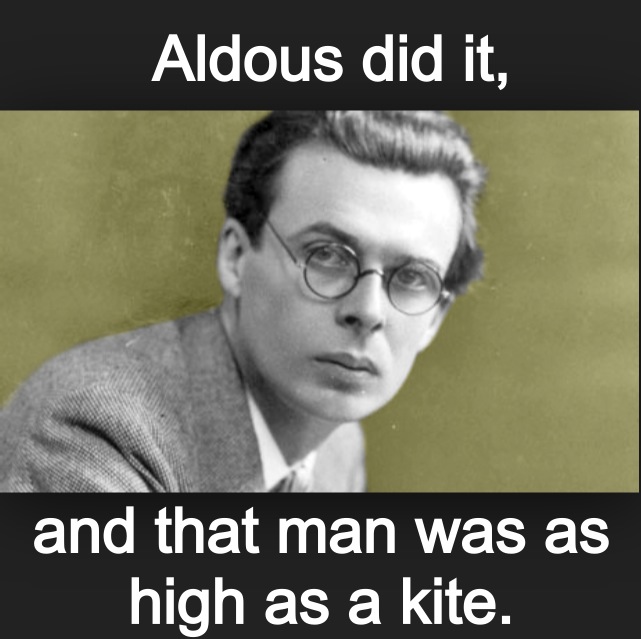
…You check your laces and get limber.  Aldous did it, and that man was high as a kite.

Whether or not I have succeeded in my endeavor, to write the next standout in the wide and ever-expanding genre of speculative fiction, remains to be seen.  (Querying would be a good first step to finding out.)  Nonetheless, the mission was in earnest, and the inspiration was solid.  If I’m worth my salt as a wordsmith, I should make out ok.  I hope, in any case, that you’ll explore and enjoy what lands here – on my blog.